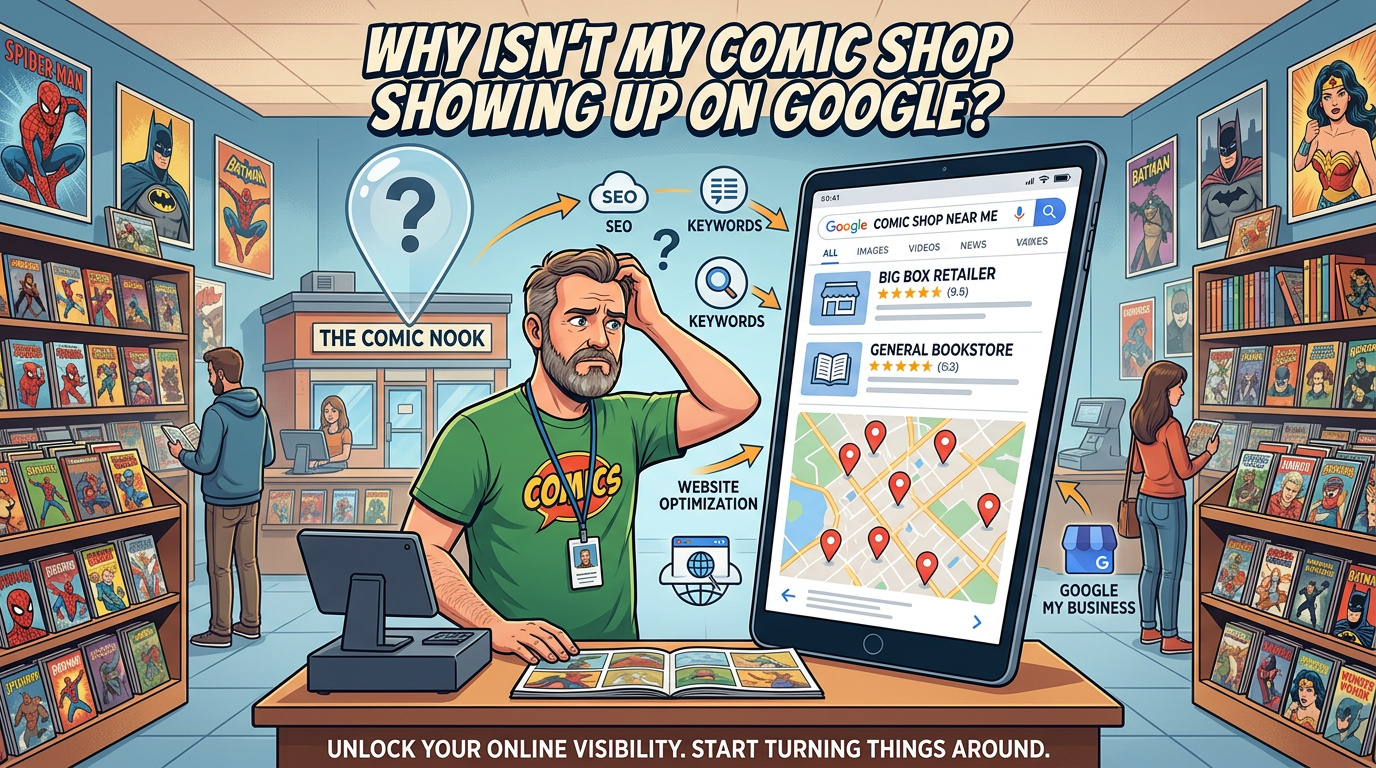
If you’ve ever asked yourself, “why is my comic shop not showing up on Google?” — you’re not alone.
Across the country, comic book store owners are facing the same frustrating reality: incredible shops with loyal in-store customers… but little to no visibility online. Meanwhile, bigger retailers — or even less relevant businesses — show up first when someone searches for a comic shop in their city.
The truth is, this isn’t random. There are clear, fixable reasons your shop isn’t ranking — and once you understand them, you can start turning things around.
The Real Reason Comic Book Stores Don’t Show Up on Google
Most comic shops don’t have a visibility problem — they have a structure problem.
Google doesn’t rank businesses based on how deep your long-box inventory runs or how knowledgeable your staff is. It ranks based on signals like:
- Website quality
- Local relevance
- Content depth
- Consistency across the web
If those signals are weak or missing, your store becomes practically invisible — even to someone standing two blocks away searching for exactly what you sell.
1. Your Website Isn’t Built for SEO
Many comic book store websites fall into one of these categories:
- Outdated and never updated
- Minimal (just hours and a contact form)
- Built on a platform that Google can barely read
This is where proper web design for comic book stores makes all the difference.
A high-performing website should include:
- Dedicated pages for your core offerings — pull lists, back issues, events, collectibles, graded comics
- Clear location-based content so Google knows where you are and who you serve
- Optimized headings and keyword usage
- Fast, mobile-friendly performance (collectors search on their phones constantly)
We consistently see comic shops trying to rank with a single-page website — which gives Google almost nothing to work with. One page can’t compete against a local game store or chain retailer with a full content library.
2. You’re Not Targeting the Right Keywords
A major reason comic shops struggle online is poor keyword targeting.
Some stores don’t use keywords at all. Others aim at terms so broad they’re impossible to compete on — like “comic books” or “Marvel comics.”
Instead, focus on intent-driven, local keywords, such as:
- “comic book store near me”
- “buy comics in [city]”
- “Wednesday new releases [city]”
- “CGC graded comics [city]”
- “first appearance comics near me”
- “comic book pull list [city]”
The last category is particularly underused. Collectors searching for CGC grading drops or first appearance keys are high-intent buyers — exactly the customers you want finding you, not an eBay listing.
You should also create content that answers real search questions like:
- “Why is my comic shop not showing up on Google?”
- “How to promote a comic book store online”
- “What’s a pull list and how does it work?”
These are the types of questions your potential customers are already searching — and right now, someone else is answering them.
3. Your Google Business Profile Isn’t Optimized
Your Google Business Profile (GBP) is one of the most important ranking factors for local visibility.
If it’s incomplete or inactive, you’re missing out on the highly visible “map pack” — those three business listings that appear at the top of local search results before anything else.
Common problems include:
- Wrong or missing primary category
- No photos of your store, your wall books, your key issues
- Inconsistent business info (hours, address, phone)
- Very few reviews — or reviews you’re not responding to
To improve your visibility:
- Add high-quality photos: your storefront, interior, new release wall, graded slabs, convention appearances
- Keep your hours updated, especially around events and Free Comic Book Day
- Use “Comic Book Store” as your primary category (not “Book Store” — it matters)
- Post GBP updates regularly, especially around new issue Wednesdays and back-issue sales
GBP optimization is often one of the fastest ways to start gaining local visibility — sometimes within weeks of making improvements.
4. You Have No Local SEO Signals
Google relies on external validation to confirm your business is legitimate and relevant. For comic shops specifically, this matters because the category is niche — Google doesn’t have as many data points to work from as it does for, say, pizza restaurants.
External signals include:
- Directory listings (Yelp, Apple Maps, Bing Places, Comic Shop Locator)
- Consistent Name, Address, Phone (NAP) information everywhere your shop is listed
- Local backlinks — mentions from local blogs, event pages, library programs, or school newsletters
If your information is inconsistent across directories — different phone numbers, abbreviations in your address, old locations — your rankings suffer because Google isn’t confident your listing is accurate.
To fix this:
- Submit your business to trusted directories, including the Comic Shop Locator (free, and specifically indexed by collectors searching for shops)
- Ensure all listings match exactly
- Get featured in local blogs, event roundups, or community pages
5. You’re Not Creating Content (This Is a Big One)
One of the biggest missed opportunities for comic shops is content creation.
Google ranks content, not just businesses. A shop that publishes helpful articles consistently will almost always outrank a shop with a static five-page website, even if the static site has a better design.
The good news: comic shops have a natural content advantage. Your inventory changes every Wednesday. New characters, new story arcs, new key issues, new speculation targets — all of it is searchable content that collectors are actively looking for.
You can create articles like:
- “Best Comics to Start Reading in 2026 (By Genre)”
- “Beginner’s Guide to Starting a Pull List”
- “Top Key Issues to Watch This Month”
- “How to Get Your Comics CGC Graded — What Collectors Need to Know”
- “Free Comic Book Day 2026: What to Expect at [Your Shop Name]”
Each of these draws a different type of searcher — new readers, existing collectors, local event-seekers — and funnels them toward your store.
6. Your Site Isn’t Internally Linked Properly
Internal linking is one of the most overlooked parts of SEO, and it’s the connective tissue that makes everything else work.
The goal is to build what’s called a hub-and-spoke structure: your main service pages (the hubs) are supported by blog posts and articles (the spokes) that link back to them. This does two things: it tells Google what your most important pages are, and it keeps visitors moving through your site instead of bouncing.
For a comic shop, that looks like this in practice:
- Your “Pull List Service” page is a hub
- A blog post like “What Is a Pull List and How Does It Work?” is a spoke — it explains the concept and links back to your pull list sign-up page
- Your “Events” page is a hub
- A blog post about upcoming releases or Free Comic Book Day links back to it
Without this structure, every page on your site exists in isolation. Google crawls it, doesn’t understand how the pieces relate to each other, and undervalues all of them.
Start by auditing your existing pages: does every blog post link to at least one service or product page? Does every service page link to at least one related article? If not, you have an internal linking gap — and it’s costing you.
7. You Don’t Have Enough Reviews
Reviews are one of the strongest ranking signals in local SEO — and one of the easiest gaps to close.
If your competitors have more reviews (and better ones), they will likely rank higher in the map pack, regardless of how good your store actually is. Google uses review volume, recency, and response rate as trust signals.
Your pull list regulars are your warmest audience. They’re already in your store every Wednesday. That’s the moment to ask — before they walk out the door. A quick “Hey, if you ever get a second to leave us a Google review, it genuinely helps” goes a long way with customers who already love your shop.
Other simple strategies:
- Add a QR code at your register linking directly to your Google review page
- Send a follow-up email or text to new pull list sign-ups after their first pickup
- Pin a “Leave Us a Review” post to your GBP so it’s visible to recent visitors
Review growth translates directly into higher visibility and more foot traffic — it’s one of the few things in SEO with a fast, measurable feedback loop.
8. Your Website Is Too Thin
Google prioritizes depth and completeness. A site with only a homepage and a contact page is considered “thin content” — and thin content simply doesn’t rank.
Think about what a collector wants to know before visiting a new shop for the first time:
- Do they have a pull list? How does it work?
- What do they stock — back issues, trades, manga, graded slabs?
- Do they buy collections?
- When are they open?
- Do they hold events?
If your website doesn’t answer those questions in depth, you’re losing that person to a shop that does. And since Google indexes these pages, you’re also losing the search traffic that would have brought them to you.
Aim for:
- 1,000–1,500+ word service pages that actually explain what you offer
- Blog content published consistently (even once or twice a month makes a difference)
- An FAQ section that answers the questions collectors actually ask
This builds authority over time and signals to Google that your site is a real resource — not a placeholder.
Final Thoughts
Comic book stores aren’t invisible on Google because of bad luck. They’re invisible because the signals Google relies on simply aren’t there yet.
Every issue we covered — your website structure, your keyword targeting, your GBP, your content, your reviews — is completely fixable. None of it requires a massive budget. It requires a plan and the consistency to execute it.
With the right foundation in place, your shop can rank higher in local search, attract new customers who didn’t know you existed, and compete with retailers that have far bigger marketing budgets.
If you’re ready to build that foundation, start with a strong web design for comic book stores strategy — and if you want expert help implementing it, that’s exactly what we do at Nostalgik Brands.
Want to know what it costs to fix all of this?